Visiting the Fort of São João Baptista in Berlengas
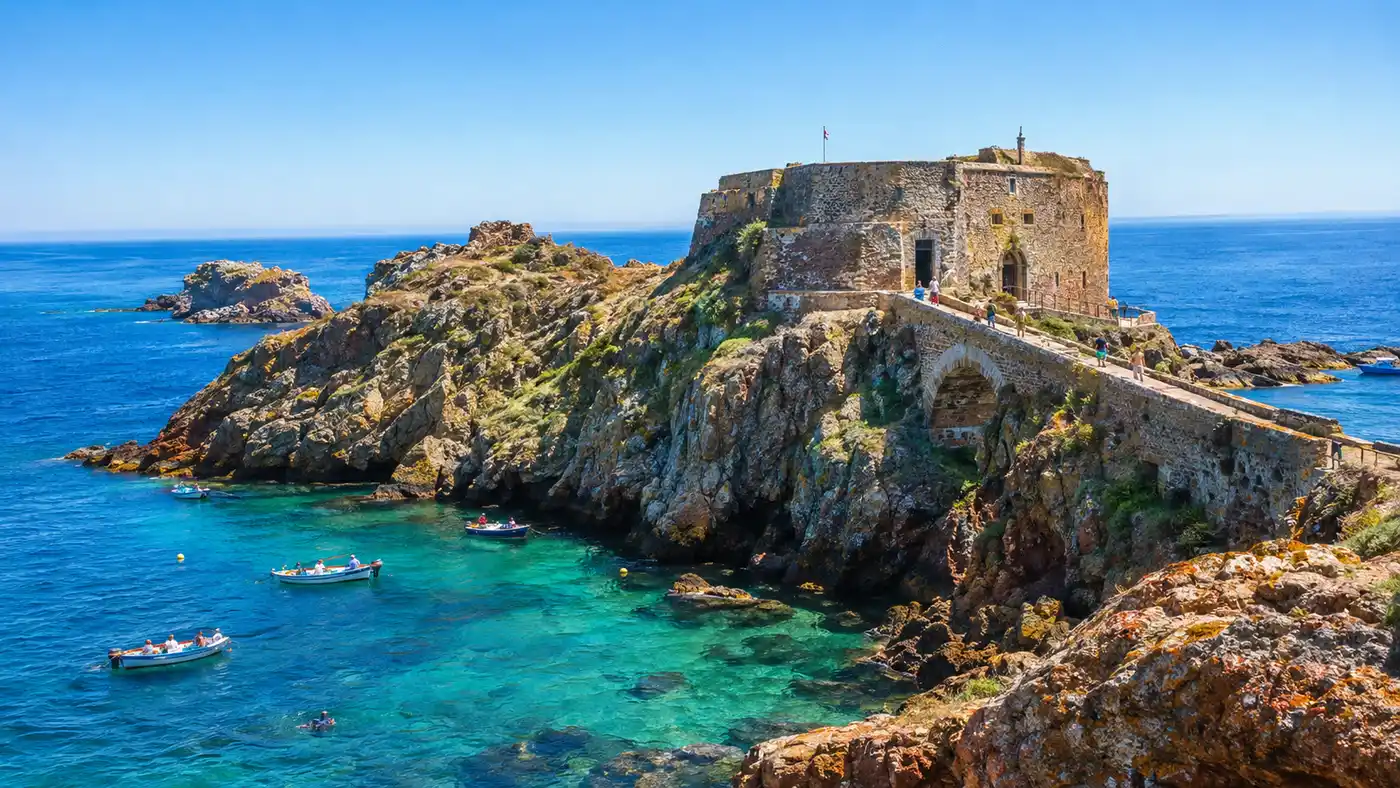
You see pictures of the berlengas fort floating around online, and they look like something a digital artist dreamt up after watching too many fantasy movies. A pentagonal stone fortress set on a tiny jagged islet, tied to the main island by winding arched bridges spanning turquoise water. It looks completely inaccessible, dropped straight into the choppy Atlantic off the coast of central Portugal. When you finally step onto those hand-cut granite cobbles after hiking down the red dirt trail from the lighthouse, the smell of salt and old wet stone hits you. It is entirely real, noisy with yellow-legged gulls, and far more battered by history than postcard photos let on.
Most people visit Berlenga Grande on a frantic three-hour ferry layover, snap twenty photos from the top of the ridge, and scramble back to the harbor before their boat leaves. That is a mistake. The fortress deserves half a day of quiet curiosity, whether you want to swim through the arches of the stone bridge, inspect the damp seventeenth-century gun emplacements, or sleep inside an old stone cell where soldiers once held off Spanish warships. Here is what you actually need to know before walking the narrow bridge out to this lonely bastion.
Book your berlengas experience:
History of the Fort of Saint John the Baptist Berlenga Island Portugal
Long before cannons were hauled up these rocks, the island was home to a tiny community of monks. Hieronymite friars settled here in 1513, tasked with rescuing shipwrecked sailors in the treacherous maritime corridor off Cabo Carvoeiro. Life out on the rocks proved brutal. Between constant Atlantic gales, a complete lack of arable soil, and repeated violent raids by Barbary pirates and French corsairs, the monks abandoned their monastery after about two decades. The site sat desolate until the Portuguese crown realized that leaving an undefended archipelago six miles off their coast practically invited enemies to set up staging bases for maritime ambushes.
In 1651, King João IV ordered a defensive bastion built directly into the shallow bay on the southeastern flank of the island. Construction finished around 1656. Builders dismantled the ruins of the old monastery to provide weathered stone blocks for the new military outpost. The result was the fort of saint john the baptist berlenga island portugal, constructed in an irregular polygon that conforms directly to the contours of the jagged reef beneath it. It was designed specifically so cannon batteries could cover every water approach without leaving blind spots for boarding parties.
The fortress earned its reputation ten years later, in June 1666. A Spanish fleet of 14 warships and two smaller vessels, carrying roughly 1,500 troops under the command of the Marquis of Serra, dropped anchor in the cove and demanded an unconditional surrender. Inside the fort, a tiny Portuguese garrison of just 28 soldiers, led by Cabo Antônio Avelar Pessoa, refused to yield. Over two grueling days, the garrison held off continuous naval bombardment and landing craft assaults. They sank one Spanish ship, heavily damaged two others, and killed around 500 enemy soldiers while losing only one man of their own.
Eventually, the Portuguese ran out of gunpowder and water. They were forced to surrender, though their fierce defense became legend in mainland military records. The fort was renovated in subsequent centuries, decommissioned in the mid-nineteenth century, and sat empty for decades before restoration groups took an interest in preserving it.
Getting Down to the Fortress: The Hike and the Bridge
Reaching the fort berlengas portugal requires some physical effort. The ferry from Peniche drops you at the tiny working harbor on the sheltered northern side of Berlenga Grande. From there, you follow the main island trail upward, past the small cluster of fishermen cabins and the island's only real beach. You will climb past the Duke of Bragança lighthouse, which hums quietly on the island's central plateau, before the path suddenly dips downward toward the southern cliffs.
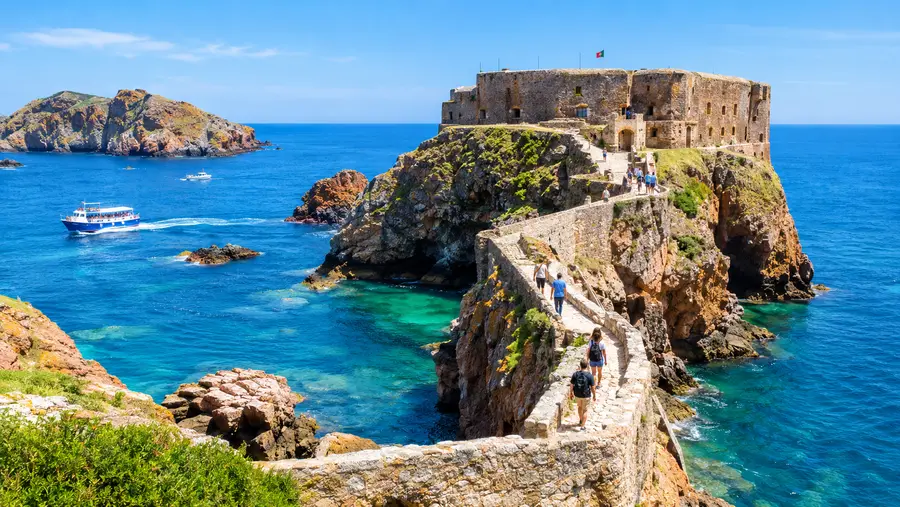
The descent is steep. You will navigate roughly 140 uneven stone-and-dirt steps carved into the hillside. The wind whips fiercely across the ridge, catching you off guard if you are holding a loose hat or a camera with a flimsy strap. Keep your hands free for balance. As you head down, the trail reveals an overhead view of the arched stone viaduct that connects the main island to the fortress islet. The causeway looks paper-thin against the dark green Atlantic surge below, curving gracefully over deep sea trenches and underwater caves.
Walking the stone bridge itself is exhilarating. There are no handrails on the causeway, just narrow spans of hand-laid masonry crossing directly above surging sea foam. If you suffer from severe vertigo, this stretch will get your heart pumping. Take your time, step over the bird droppings, and pause midway to look down into the crystalline water of the cove. On calm days, the water is transparent enough that you can count sea urchins and bream resting five meters below the surface. This iconic walk out to the berlengas fort remains one of the most surreal strolls anywhere in Iberia.
Pro tip: Wear proper trail-runners or running shoes for the hike down. The red dirt on the staircase turns slick with maritime humidity, and the uneven granite pavers along the bridge viaduct will twist an ankle fast if you try walking them in rubber flip-flops.
Inside the Walls: What to Expect Today
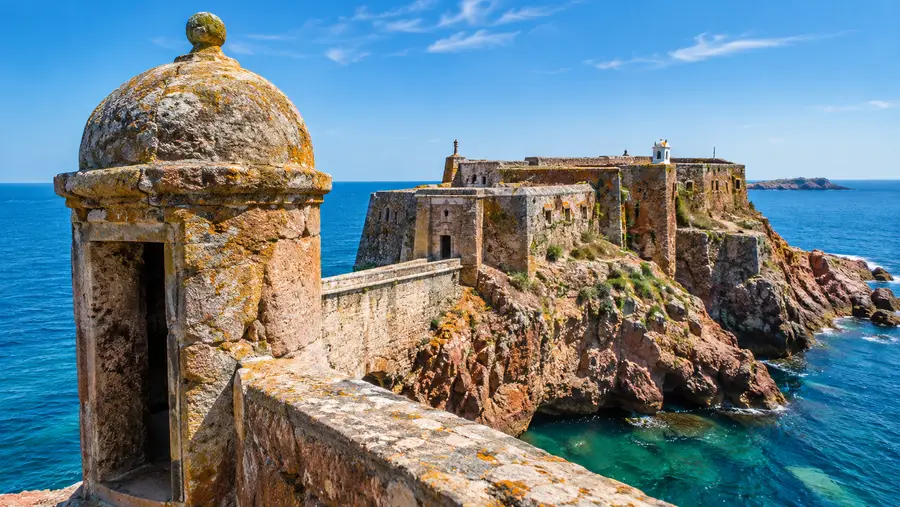
Crossing through the main arched gateway brings you into an interior that feels stark, utilitarian, and weathered by three and a half centuries of saltwater spray. There are no museum docents, velvety ropes, or glossy display plaques here. The fort of the berlengas is maintained primarily by the Associação dos Amigos das Berlengas, a non-profit preservation group that keeps the structure standing through sheer volunteer will and visitor fees.
A narrow, sheltered courtyard opens up in the middle, lined with thick-walled vaulted chambers that once served as soldier barracks, ammo magazines, and grain storage. Today, those same cavernous chambers serve as simple overnight dormitory rooms and an unpretentious café counter that operates during peak summer months. You can climb narrow stone stairways up to the top ramparts, where ancient cannon ports look straight out across the ocean horizon. From this vantage point, looking back toward the mainland, you realize just how isolated this outpost truly was for the men stationed here.
The architecture is purely functional. Granite arches carry the roof loads, and the exterior walls are thick enough to absorb hits from seventeenth-century round shot. Moisture drips steadily inside the darker corridors, leaving mineral traces along the joints. It feels completely raw. If you are accustomed to polished, gift-shop-heavy tourist monuments on the mainland, the austere honesty of this place will come as a welcome shock.
Book your berlengas experience:
Exploring the Waters: Kayaking, Snorkeling, and Boat Pickups
Looking at the fortress from land is only half the experience. The water surrounding the outpost forms part of a strictly protected UNESCO biosphere reserve, and the marine environment under the bridge arches is astonishingly healthy. The granite reefs drop off into deep emerald water populated by large schools of sea bass, spider crabs, octopuses, and bright orange sea stars. Swimming here is brisk - ocean temperatures rarely rise above 18 degrees Celsius even in August - but slipping on a mask and jumping in off the fort's small boat landing is unforgettable.
If you prefer to stay dry, local skippers operate small glass-bottom boats and rubber zodiacs that dart into the narrow sea caves tucked right beneath the trail. You can arrange for a boat to pick you up at the fort's dock and whisk you back to the main harbor through the caves, saving your knees the punishing climb back up the stairs. Kayaking is another fantastic option for exploring the rock arches, though you should only attempt it on calm days when the Atlantic swell is manageable.
| Activity | Route / Access Point | Physical Effort | Cost | Highlights |
|---|---|---|---|---|
| Overland Hike | Harbor via Lighthouse Trail | Moderate to High | Free | Panoramic cliff views, crossing the stone viaduct on foot |
| Zodiac Shuttle | Harbor dock to Fort landing | Very Low | Around €8 - €12 | Passes sea caves, avoids the 140-step climb back up |
| Sea Kayak | Rentals at Praia do Carreiro | Moderate | €15 - €25 / hour | Paddling directly under the bridge arches and into sea caves |
| Snorkeling | Direct entry from the fort pier | Moderate (cold water) | Free with own gear | Kelp forests, dense bream schools, submerged canyon walls |
If you plan on getting in the water, keep in mind that currents around the outer reefs can pick up unexpectedly when the tide turns. Stick close to the sheltered inner bay between the fortress and the island cliffs, where the water stays remarkably calm even when open sea chops against the outer ramparts.
Note: The island operates on a daily visitor quota enforced by the government. You must register for an official Berlengas Pass online before boarding your boat in Peniche, or the maritime police will turn you away at the harbor.
Sleeping at the Fort: Logistics and Survival Tips
Yes, you can actually sleep out here. The fortress operates as a rustic hostel, offering a handful of bare-bones private rooms and dorm beds inside the old vaulted stone cells. It is easily one of the most unique overnight stays in all of Southern Europe, but anyone seeking resort luxuries will be deeply miserable. You are essentially indoor-camping inside a seventeenth-century military relic on a desert island.
You have to bring your own sleeping bag, your own bath towel, and plenty of supplies. Fresh water is piped in limited amounts from mainland tanks, which means showers are strictly regulated and cold. The electricity comes from rooftop solar panels and small generators, shut down reliably by 11:00 PM to conserve power. Once those lights snap off, the dark settles in completely, broken only by the sweeping white beam of the distant lighthouse and millions of stars overhead.
Before packing your backpack, run through these essential preparation steps:
- Book your bed months ahead: Rooms are managed directly by the volunteer association and sell out early for summer weekends.
- Carry your own trash out: There is no municipal garbage collection on Berlenga; whatever plastic, wrappers, or cans you haul in must go back to Peniche in your pack.
- Pack easy dry meals: The fortress has a small kitchen space for guests, but utensils are sparse and there is no grocery store anywhere on the island.
- Bring a sturdy headlamp: Finding your way to the communal bathroom along unlit vaulted stone corridors in pitch darkness requires a reliable flashlight.
For visitors who prefer a bed with modern plumbing and reliable hot water back on the mainland, staying overnight at the fort might sound too rustic. If you want more details on the exact booking process and alternatives on the island, check our full Berlengas Island Accommodation Guide to compare every lodging option. Otherwise, taking the mid-morning boat across from Peniche and spending four relaxed hours exploring the ramparts offers the ideal balance for most day-trippers.
Before booking any ferry ticket, remember that the ocean crossing can be notoriously rough. Even on bright, sunny afternoons, the crossing across the oceanic shelf from Peniche takes about 35 to 45 minutes on modern catamarans and can bounce violently on smaller rigid-hulled inflatables. For a detailed breakdown of ferry schedules, operators, and seasickness advice, look through our Peniche to Berlengas Ferry Guide before locking in your day trip.
A few quick packing habits will make your day at the fort infinitely better:
- Windproof jacket: The Atlantic breeze hits the top of the island ridge hard, even during blistering hot July afternoons.
- Cash in small bills: The little cantina inside the fort does not always have working satellite card terminals.
- Reef-safe sunscreen: The marine reserve hosts sensitive fish nurseries, so avoid washing harsh chemical lotions into the cove waters.
- Wetsuit top: If you plan on snorkeling around the arches for more than fifteen minutes, a 2mm neoprene top makes all the difference against the 16-degree water.
Frequently Asked Questions about berlengas fort
How much does it cost to enter the fortress?
Walking across the bridge and exploring the ramparts costs nothing beyond your island ferry ticket. If you stop at the modest volunteer-run café inside the courtyard, a simple espresso or bottle of water costs around €1.50 to €2.50, cash only.
Can you visit the fortress year-round?
Regular ferry crossings only run from late spring through early autumn, typically between May and October. During winter months, massive Atlantic storms frequently submerge the low stone viaduct, making both boat crossings and walking to the fort nearly impossible.
Is the trail down to the fort suitable for small children?
Older kids will love the adventure, but parents with toddlers should exercise extreme caution. The descent down the dirt stairs is steep, and the stone viaduct crossing has zero safety barriers or railings on either side above deep drop-offs into the sea.
How long does it take to walk from the ferry dock to the fort?
The hike covers roughly 1.5 kilometers across the island ridge and takes about 25 to 35 minutes at a steady pace. Factor in extra time to catch your breath on the climb back up, especially under direct midday sun.
Quick Reference
- Location: Southeast reef of Berlenga Grande Island
- Construction date: 1651 to 1656
- Access: Steep trail followed by a narrow stone causeway
- Facilities: Basic seasonal café and rustic hostel rooms
- Island permit: Mandatory online Berlengas Pass before arrival
Book your berlengas experience:
Is It Worth the Trek?
Standing on the upper rampart while the ocean swell slaps the outer masonry leaves an impression few castles in Europe can replicate. The fort does not coddle visitors with interactive screens or souvenir kiosks. It is simple, weathered, salty, and wonderfully stubborn. If you make the journey across the channel from Peniche, make sure you take the trail all the way down to the rocks. Cross the stone arches, sit on the sun-warmed granite, and spend an hour just listening to the waves rumble through the sea caves beneath your feet.
Read more about berlengas.